
A Guide/FAQ to the False Claims Act and “Qui Tam” Cases for Non-Lawyers

False claims to federal health care programs can give rise to civil liability and even criminal liability.

The False Claims Act can be a powerful tool to combat fraud, waste and abuse, but it is often misunderstood and used ineffectively.  I was a federal prosecutor who worked on multiple criminal and civil cases involving the False Claims Act and I’ve also worked on these cases in private practice, and I wanted to provide this guide to the False Claims Act for non-lawyers.

What is a False Claims Act case? 

The federal government can bring a civil lawsuit under the False Claims Act (“FCA”) against anyone who has presented a false or fraudulent claim to a government program.  This is one of many tools available to the government, and it has advantages and disadvantages compared to other tools.

For the government, one advantage of bringing a case under the False Claims Act is that the government has a lower standard of proof (preponderance of the evidence) compared to criminal cases (beyond a reasonable doubt).  Another advantage is that the government can sometimes get more money back in FCA cases than it can in criminal cases or in administrative audits – FCA cases result in civil penalties of at least $5,000 per false claim in addition to three times the damages suffered by the government.

At the same time, FCA cases have limits, especially compared to the criminal cases that I primarily handled.  First, the government cannot use certain investigative techniques such as grand juries and undercover recordings in FCA cases.  Second, there is no possibility of jail time as a penalty, which hopefully is some comfort to those who have been sued under the FCA.

What is a “qui tam” or whistleblower case?

The federal government can bring an FCA case on its own, but most FCA cases now are initiated by private individuals who act as “relators” and bring lawsuits in the name of the United States.  Lawsuits brought by individuals on behalf of the United States are called “qui tam” or whistleblower lawsuits, and these lawsuits have increased dramatically in number and significance over the past few decades.

For the government, the advantage of a “qui tam” lawsuit is that private individuals have a financial incentive to develop strong cases of fraud, waste and abuse in government programs.  As a result, the government has recovered money in some cases that it would not have known about otherwise.  

On the other hand, this financial incentive can also bring out people who may not have strong cases.  This can distract the government and waste time and resources from better cases that the government could develop on its own.

Most “qui tam” lawsuits are brought by former employees who have inside knowledge of how a fraud was working and may have tried to stop the fraud, but who also may have baggage that affects their credibility. 

At the same time, nothing in the False Claims Act limits relators to former employees – any person can bring a “qui tam” case if they have non-public information about false claims.  In recent years, some “qui tam” cases have been brought by individuals or companies that realized what their competitors were doing. Publicly-available data also can be mined to develop potential False Claims Act cases, though data alone is probably not enough to bring a case. 

What happens when a “qui tam” case is filed? 

A relator, usually via a lawyer, begins a case by filing a complaint in federal court under seal.  The government then has at least 60 days (usually much more) to decide whether the government wants to “intervene” in the case, basically taking over the lawsuit.  During that time, the government investigates the case, often via law-enforcement agents such as special agents at the FBI or the Department of Health and Human Services – Office of Inspector General.

In my experience, the first steps by the government in an FCA case were typically (1) interview the relator and review any materials that the relator provides and (2) pull the claims data.  Data helps the government determine whether there is any substance to the allegations.  I’ve used data to quickly corroborate allegations, and I’ve also used data to show that the allegations were weak and did not warrant further investigation.  

After investigating, the government has to make a decision about how to proceed:

  • The government could decide to “intervene” in the lawsuit, basically taking over part or all of the lawsuit from the relator.  In this situation, the government can conduct discovery as in a civil case and will probably try to reach a settlement or go to trial.
  • The government could decide that the allegations are serious enough to warrant criminal prosecution, as happened in many cases that I worked on.  The “qui tam” lawsuit often is put on hold while the criminal case proceeds.
  • The government could decide to not intervene in the lawsuit.  Relators then are allowed to pursue the lawsuit on their own.  Some relators pursue their cases and can win large awards.  But many cases fail without the resources and tools that the government has available.  
  • The government can also decide that the allegations are meritless and dismiss the lawsuit entirely

What kinds of cases are brought under the False Claims Act?

Most “qui tam” cases relate to a federal health care program such as Medicare, Medicaid, or TRICARE.  In the 2010s, about 70 percent of new “qui tam” cases each year related to federal health care programs, a big change from the late 1980s and early 1990s when most cases related to the Department of Defense.

Looking back over the cases that have resulted in settlements or judgments in 2020, here are some common types of health care FCA cases:

  • Unnecessary services.  Services typically should be billed to a health care program or insurer only if the services were medically necessary (preventative care generally is not covered).  Accordingly, if Medicare is paying for a service that was not medically necessary, the government views that as a false claim.  For example, in 2020, there were several cases involving unnecessary tests, such as cases where patients were automatically given urine drug tests without any determination of necessity.
  • Upcoding.  Services typically are billed based on the patients’ need and the complexity of services performed.  “Upcoding” is a term for services that are billed as if they were more complicated than they actually were, typically so the provider can get more money than he or she should.  In 2020, there were multiple cases involving skilled nursing facilities that billed as if patients were receiving the highest level of services even when they did not need such services.  There was also a case involving the billing of work done by nurse practitioners at the higher reimbursement rate associated with doctors.
  • Kickbacks.  Financial incentives that violate the Anti-Kickback Statute can render a claim “false” for purposes of the False Claims Act.  In 2020, there were cases involving multiple types of kickbacks: (1) sham medical director agreements, (2) payments to referring physicians based on the volume or value of referrals, and (3) free phone services or advertising assistance.  Some cases also involve violations of the Stark law, which generally prohibits physicians from referring patients to entities with which they have a financial relationship.

How do people know that there is a “qui tam” lawsuit filed against them? 

Because cases are filed under seal, people probably will not know there is a “qui tam” lawsuit filed against them until they are served with a complaint and summons, which may occur years after the initial filing. 

Still, there are some signs that the government is conducting a covert investigation based on a “qui tam” lawsuit.  One sign is if you receive a “civil investigative demand” for documents or testimony.  Another sign is if you learn that agents are interviewing former employees – interviewing current employees can trigger ethical obligations that can limit investigative steps, but interviewing former employees is a common investigative technique. 

What kind of defenses are there to a “qui tam” lawsuit?

Individuals and companies who are faced with a “qui tam” lawsuit can and should evaluate the allegations carefully to determine how to defend themselves.  Here are some common defenses:

  • The claims were not false.  A difference in medical opinion is generally not enough to render a claim false or fraudulent.  To prove that a claim is false or fraudulent, the government or relator should show that the services were not actually rendered, that the provider did not actually believe that the patient actually had the diagnosed condition, or that no reasonable provider could have concluded that the service was necessary or that the patient had the diagnosed condition.  Some courts also allow lawsuits based on the idea that the services, though rendered, were so substandard and “worthless” that the claims for those services were effectively false.
  • Errors or problems were not done “knowingly.”  Mistakes happen frequently in medical billing, and mistakes should be handled through audits, not through the FCA.  In an FCA case, the government or relator must prove that the defendants (1) had “actual knowledge” that a claim was false, (2) acted in “deliberate ignorance of the truth or falsity” of the claim, or (3) acted in “reckless disregard of the truth or falsity” of the claim.  
  • The allegations in a complaint are too vague.  In an FCA case, the government or relator must “state with particularity the circumstances constituting fraud or mistake” in their complaint.  Vague allegations are not enough, and complaints sometimes can be dismissed if the relator cannot connect their allegations to a specific false claim.
  • The allegations relate to errors or problems that are immaterial.  Minor problems with how services are rendered are not significant or “material” enough to give rise to an FCA case.  For example, if a hospital fails to comply with some government or contractual requirement, that does not necessarily render every claim it has submitted false. 

Another defense is to limit the “damages” that the government or relator can prove.  One false claim does not mean that every claim is false.  In FCA cases, the government is not required to review every claim at issue, but can prove damages in other ways.  Typically, this involves an expert reviewing a “sample” of claims and a statistician extrapolating from the expert’s review against the larger “universe” of claims.  Defendants can challenge the expert’s conclusions and should check whether the extrapolation is done correctly. 

Defendants in “qui tam” cases should keep in mind some warnings.  

  • First, do not disregard an FCA case just because the relator was fired or left on bad terms or is a competitor. Successful FCA cases rarely rely on a single witness, and the government can build a case around the allegations of someone even if that person would be a terrible witness at trial or does not even get called at trial.  In fact, firing employees who raise concerns can give rise to retaliation claims under the FCA and can even become powerful evidence of criminal intent. 
  • Second, even if the government decides to handle a case civilly, the government can sometimes still bring criminal charges, especially if the government learns or believes that files have been falsified in response to a civil investigative demand or audit.  
  • Third, even if the government decides not to intervene, the government sometimes can intervene later, particularly if a relator develops significant new information in discovery. 

What can someone get for becoming a relator?

Relators can get a share of the money that the government gets back via a False Claims Act, typically ranging from 15 percent to 25 percent, more if the government does not intervene.  If there are multiple relators who have filed separate lawsuits, recovery is generally limited to the first relator who brings an action, which creates an incentive to file early.

In 2020, relators in health care FCA cases that the government handled and that resulted in settlements got awards ranging from $58,087 for a case involving upcoded services to $10 million for a former hospital executive who reported violations of the Anti-Kickback Statute. 

But potential relators should consider the following before bringing a “qui tam” case.

  • First, vague allegations of problems are not going to be enough, given the defenses discussed above.  Isolated problems are also not going to be enough, given the amount of resources that bringing a successful case can take. 
  • Second, these cases can take a long time.  Several cases that resulted in settlements in 2020 were filed in 2011, 2012, and 2013, meaning that relators waited a long time before receiving anything. 
  • Third, relators get nothing if the case does not result in a settlement or judgment.  Good cases sometimes end up with no recovery because of problems in how the case was investigated or handled. Relators can even be ordered to pay attorneys’ fees if the government does not intervene, if the defendant prevails at trial, and if a court finds that the claim was “clearly frivolous, clearly vexatious, or brought primarily for purposes of harassment.” 
  • Fourth, if you were part of a fraud, becoming a relator does not automatically immunize you from prosecution.  Going along with a fraud for years and then filing a “qui tam” complaint is very risky.  
  • And finally, if your goal is to stop an ongoing fraud, there may be more efficient and effective ways of doing so, such as calling a tip line with a Medicare contractor, the FBI or HHS-OIG.  You might be able to maintain your anonymity and you might even have more credibility as a witness if you do not have a financial incentive in the outcome of the case.

Hope this helps.  If you have additional questions specific to your situation, consider consulting and retaining an attorney. 

Stephen Lee was an Assistant United States Attorney in Chicago from 2008 through 2019 and served as senior counsel to the healthcare fraud unit in the U.S. Attorney’s Office for the Northern District of Illinois. He is now in private practice in Chicago. In his first year in private practice, he was counsel to a doctor in a seven-week Medicare Strike Force trial in the Southern District of Texas, in which he helped win the acquittal and dismissal of multiple charges, including all charges against three co-defendants.

What data reveals about the Farid Fata case

The case of Farid Fata has gotten a lot of new attention recently with season 2 of the popular Dr. Death podcast, and it is a useful example of what data can reveal about health care fraud.  Data probably could have caught Fata even earlier, and data helps suggest an answer to one of the most troubling questions that the Fata case raises – are or were there other doctors out there like him?

For background, Farid Fata was a hematologist/oncologist in Michigan who was arrested in August 2013.  A year later, he pled guilty to health care fraud, conspiring to receive kickbacks, and money laundering.  In 2015, Fata was sentenced to 45 years in prison.

According to the government’s sentencing memorandum, Fata was “the most egregious fraudster in the history of this country, measured not by the millions of dollars he stole but by the harm inflicted on his victims, over 550 identified so far.”  According to the government, Fata “deliberately misdiagnosed” patients so he could administer and bill unnecessary chemotherapy, lied to patients about their chances of recovery, and gave patients unnecessary treatments.

At sentencing, the government had to establish a “loss” amount associated with Fata’s fraud.  The government did an extensive workup, including having two experts review more than 125 patient files.  This detailed review was the basis for the largest component of loss – about $7 million in payments.

The second-largest component of loss related to Fata’s use of Rituximab, an antibody infusion.  According to the government, Fata told patients who were in remission from cancer that they needed “maintenance” treatments of Rituximab so they would not relapse.  He claimed that this was supported by a made-up “European” or “French protocol,” and falsified documents to support this fake study.  Fata also gave Rituximab to treat a condition (ITP) that some patients did not have.  Fata’s use of Rituximab caused a loss of about $6.2 million in payments.

These two categories make up the vast majority of the $17 million “plus change” in loss that a federal judge found to have been caused by Fata.

I was a federal prosecutor in Chicago from 2008 to 2019, and I analyzed data extensively to investigate and prosecute multiple health-care fraud cases against doctors, companies, and others.  To me, data was a witness who could provide great insights into what a defendant was doing and how the defendant was doing it, and I spent lots of time “debriefing” that witness, corroborating what I learned, and testing theories.  That work led to several successful prosecutions, and I’m probably one of the few attorneys who has taught multiple juries how to use Microsoft Excel so they could analyze the data themselves.

I understandably no longer have access to the detailed data that I did when I worked for the government.  But Medicare has made publicly available a lot of aggregate data for medical professionals and companies that bill to Medicare, and that data can still reveal a lot about what Medicare providers are doing and how they are doing it.

A look at Fata’s Medicare data for 2012 reveals multiple red flags that tie to his fraud as laid out in the government’s sentencing memorandum.  2012 is the earliest year for which Medicare aggregate data is available online, and it happens to be the last full year before Fata was arrested.

First, Fata was one of the top 10 doctors in the United States in terms of Medicare payments, with about $10 million in payments in 2012.  That’s not a crime in and of itself.  But as I often say, if you’re one of the top-paid doctors in the country or for a high-cost procedure, you should have a good explanation why.  Notably, of those top 10 doctors, at least four of them have been investigated by the federal government – Fata pled guilty, a second was convicted at a jury trial, a third agreed to pay millions and be excluded from Medicare for unnecessary procedures, and a fourth was charged in 2019.   

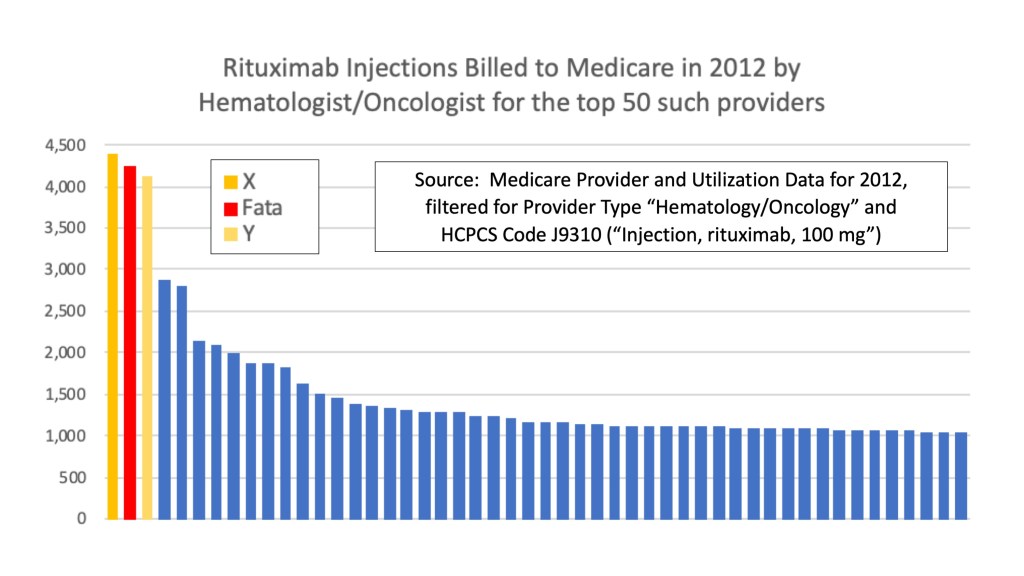
Second, Fata was one of the top hematologists/oncologists in the United States in terms of Rituximab injections (billing code J9310), which was a large part of Fata’s criminal conduct.  According to the publicly available data, Fata billed about 4,256 Rituximab injections to Medicare in 2012, ranking #2 in the country.  Again, that’s not a crime in and of itself, but he was one of only three doctors in the country who billed this kind of volume (we’ll come back to those other two, whom I will call Doctor X and Doctor Y).

Third, Fata was the top hematologist/oncologist in the United States in terms of the number of services that he was billing to Medicare.  He did not have the largest patient population (about 1,343 unique beneficiaries, ranking him about #154 in the country) and he did not have the highest ratio of payments per beneficiary, but he was billing a lot more services than other hematologists/oncologists.  In 2012, Fata billed 908,406 services to Medicare, ranking him #1 among hematologists/oncologists in the country.  The #2 hematologist/oncologist in the country billed about a third less than Fata, billing “only” 571,723 services.

Fourth, Fata was the top hematologist/oncologist in the United States for another procedure that was revealed to be part of his fraud – injecting ferumoxytol for the treatment of iron deficiency anemia.  He billed 304,980 such procedures, much more than the #2 hematologist/oncologist, who billed “only” 199,410 of such services.

These are all red flags that can be seen in the publicly available data.  More probably can be seen in the full data set that I do not have access to.

Unfortunately, none of these red flags, individually or collectively, apparently led to the case against Farid Fata.  On August 6, 2013, the government filed an affidavit in support of an arrest warrant against Fata.  The government does not have to reveal everything that it knows at that point, but affidavits like these help show what the government knew and had done by that point.  

The affidavit is heavily based on interviews of some of Fata’s employees, the first of which occurred just four days earlier, on August 2, 2013.  According to the affidavit, the government did look at Fata’s data and did determine that Fata had billed for more drug infusions than any other hematologist/oncologist in Michigan during the prior two years, but discusses none of the specific red flags that I discussed above.

The Fata case apparently came to light because of employees who talked to the government in August 2013, and the government acted quickly based on that information.

It is not clear whether the government should have caught onto Fata earlier.  But the government probably could have.

Data reveals a lot about a provider’s practice.  The government is checking data for red flags, and hopefully the government is refining its methodologies as it learns more about how people like Fata have gamed the system.

In fact, what I’ve seen in looking at the Fata case and his data may help provide a partial answer to a troubling question that I think is raised by his case:  Are or were there other doctors like him out there?

In terms of hematologists/oncologists, there were at least two others whose publicly available data in 2012 looks similar to Fata’s.  These doctors, whom I referred to above as Doctor X and Doctor Y, are hematologists/oncologists like Fata and they are not based in Illinois (where I was a federal prosecutor).  As far as I can tell, Doctor X and Doctor Y have not been charged with a crime, have not had any kind of public settlement with the government, and have not had any disciplinary actions taken against their medical licenses. 

In 2012, Doctor X was one of the top Medicare providers in the United States, based on total payments.  Doctor X was even paid more by Medicare than Fata was, according to Medicare data.

In 2012, Doctor X even billed more Rituximab injections in 2012 than Fata did, according to Medicare data.

These facts should raise some red flags, but they are not in and of themselves signs of crimes.  But there’s another big red flag that I’ve seen in the data.

Since Medicare data became publicly available and since Fata was charged, Doctor X has stopped billing for Rituximab injections entirely, at least for Medicare patients.  Doctor X billed about 4,384 Rituximab injections in 2012, about 3,526 injections in 2013, about 1,562 in 2014, and zero in 2015, according to publicly available Medicare data.

According to Doctor X’s data, he was billing a large amount of injections and infusions in 2012.  But in 2015, he billed no injections and infusions at all.  According to the publicly available data, in 2015, Doctor X was largely seeing patients for office visits that were somewhat complicated and occasionally providing hospital inpatient care, conducting a largely typical doctors’ practice.

Doctor X was one of the top-paid Medicare providers in the country in 2012, but he fell massively off the charts just three years later.

Those changes are a massive red flag.

We see similar red flags for Doctor Y.  According to Medicare data, Doctor Y also was one of the top-paid Medicare providers in the country in 2012 (in the top 20) and billed the third-highest number of Rituximab injections in the country, just under Fata.  And like Doctor X, by 2015, his payments dropped significantly and he billed no injections of any kind. 

I do not know what happened there.  Maybe Doctor X and Doctor Y got tired of doing large numbers of injections and decided to make massive career changes.  Or maybe Doctor X and Doctor Y were investigated by someone and decided to lay low.  Whatever happened, I hope someone did take a look at these doctors, and I really hope that their patients (or former patients) are okay.

Putting aside Doctor X and Doctor Y, the data does provide some indication that there are no other hematologists/oncologists quite like Fata, at least in terms of Rituximab injections, at least any more.  There were no hematologists/oncologists billing the same volume of Rituximab injections in 2013, 2014, 2015, 2016, or 2017 (the last year for which Medicare data is publicly available).

For those readers who are doctors, I strongly encourage you to take a look at your data.  That’s what the government is looking at to see if you are an outlier or if there are red flags, and you should know how the government might view you.  If you need help doing so, please consult a medical biller or an attorney.  I’ll also write more about this in the future.

And for those readers who are attorneys, I encourage you to think of data as a witness.  Witnesses generally do not walk into your office and give you everything that you want to know.  You would and should take your time debriefing witnesses.  You should think of data the same way.

Thanks for reading.  Hope you enjoyed.

Stephen Lee was an Assistant United States Attorney in Chicago from 2008 through 2019 and served as senior counsel to the healthcare fraud unit in the U.S. Attorney’s Office for the Northern District of Illinois. He is now in private practice in Chicago. In his first year in private practice, he was counsel to a doctor in a seven-week Medicare Strike Force trial in the Southern District of Texas, in which he helped win the acquittal and dismissal of multiple charges, including all charges against three co-defendants.
Willfulness – the often-overlooked element in healthcare fraud and kickback cases

When it comes to healthcare fraud and kickback cases, I believe many attorneys – both prosecutors and defense attorneys – overlook one important element – “willfulness.”

There are four main federal criminal statutes covering healthcare fraud (18 U.S.C. 1347, the Anti-Kickback Statute, false statements, and obstruction). All of them require the government to prove beyond a reasonable doubt that the defendant acted “willfully.” 

Willfulness is the key element that distinguishes a criminal case from a case that should be handled civilly or administratively.  Prosecutors and law-enforcement agents often take this element for granted, but attorneys and practitioners should examine this element more closely.

So what does it mean to act “willfully”?

Five circuits define “willfully” in their pattern jury instructions in the same way, basically, that the government has to prove beyond a reasonable doubt that the defendant knew that what he or she was doing was illegal.

  • 1st Circuit:  “An act or failure to act is ‘willful’ if done voluntarily and intentionally, and with the specific intent to do something the law forbids, or with specific intent to fail to do something the law requires to be done; that is to say, with bad purpose either to disobey or to disregard the law.”  Instruction 4.18.1347 (healthcare fraud).
  • 3rd Circuit:  “That [defendant] knew [his/her] conduct was unlawful and intended to do something that the law forbids.  That is, to find that [defendant] acted willfully, you must find that the evidence proved beyond a reasonable doubt that [defendant] acted with a purpose to disobey or disregard the law.” Instruction 5.05 (note that the 3rd Circuit does not specifically include “willfully” in its healthcare fraud instruction – make sure to ask for this to be included!).
  • 5th Circuit:  “[T]he act was committed voluntarily and purposefully, with the specific intent to do something that the law forbids; that is, to say, with bad purpose either to disobey or disregard the law.”  Instruction 2.59 (healthcare fraud).
  • 8th Circuit:  “A defendant acts willfully if he knew his conduct was wrongful or unlawful.”  Instruction 6.42.1320 (note that this definition is included in the instruction for Anti-Kickback Statute violations but not in the definition for healthcare fraud cases – make sure to ask for this definition to be included in all types of HCF cases!).
  • 11th Circuit:  “The act was committed voluntarily and purposely, with the intent to do something the law forbids; that is, with the bad purpose to disobey or disregard the law.”  Instruction B9.1A (note that the 11th Circuit did not specifically include “willfully in its healthcare fraud instruction – make sure to ask for this to be included!). 

Two other circuits have language in their pattern jury instructions suggesting similar instructions:

  • The Seventh Circuit’s pattern jury instructions for healthcare fraud do not define “willfully,” but notes that one 2008 case suggests that “willfully” requires proof that a defendant knows that his or her conduct was “in some way unlawful.”  In the cases that I handled as a prosecutor in Chicago, we included a version of that definition.
  • The Ninth Circuit’s jury instructions for healthcare fraud and the Anti-Kickback Statute refer to willfulness, and the notes for Instruction 5.5 state that willfulness in healthcare fraud cases generally require knowledge that a defendant’s conduct was unlawful.

Following these circuits, willfulness means more than just unethical or immoral or sketchy. While the government does not have to prove that an individual knows the particular statutes that he or she violated, the government has to prove that the individual knew that their conduct violated some law.

Please note that the Sixth Circuit does NOT define willfully the same way as other circuits.  In its healthcare fraud instruction (10.05), the Sixth Circuit defines “knowingly and willfully” as follows: “An act is done ‘knowingly and willfully’ if it is done voluntarily and intentionally, and not because of mistake or some other innocent reason.”

The Sixth Circuit’s instruction is, I believe, incorrect as it treats “willfully” as synonymous with “knowingly.”  It also appears to not take into account an important case on this topic – United States v. Ajoku (08-1094 in the Central District of California, 11-50230 in the Ninth Circuit, and 13-7264 before the Supreme Court).

In 2011, Kelechi Ajoku, a licensed vocational nurse, was convicted by a jury of making false statements in a healthcare matter under 18 U.S.C. 1035.  Defense counsel had asked that willfulness be defined as requiring proof that the defendant “acted with knowledge that his conduct was unlawful.”  The district court rejected this request and gave instructions that treated “willfully” as synonymous with “knowingly.”

In 2013, the Ninth Circuit affirmed that instruction.  The Ninth Circuit wrote that, “[i]n the context of false statement cases … willfulness simply means ‘deliberately and with knowledge,’ and does not require knowledge of unlawfulness.” 

The case was appealed to the Supreme Court.  In 2014, the Solicitor General confessed error, and the Supreme Court vacated the judgment. 

In 2015, Ajoku was re-tried. 

This time, the district court separated “knowingly” and “willfully” in the instructions.

This time, the district court told jurors that the government had to prove that Ajoku had acted “willfully, that is, with a bad purpose.  In other words, the defendant committed the act voluntarily and purposefully, and with knowledge that his conduct was unlawful.”

This time, Ajoku was found not guilty.

Unfortunately, the Sixth Circuit’s jury instruction on healthcare fraud has not been updated in light of the Ajoku case.  There may be people who have been convicted under this definition and who should not have been convicted.

If you’re in the Sixth Circuit, ask for a “willful” definition that fits with other circuits.

In terms of evidence, attorneys should look carefully at the facts to determine whether the government actually can prove willfulness in particular cases.  Here are some questions to consider:

  • Did a defendant sign a Medicare provider enrollment form?  If he or she did, the government will use that form as evidence of willfulness because signing that form (1) establishes knowledge of the healthcare fraud statute and the Anti-Kickback Statute and (2) contains the statement:  “I will not knowingly present or cause to be presented a false or fraudulent claim for payment by Medicare.”  But if a defendant did not sign a form, the government may have difficulty proving that he or she acted willfully, particularly when it comes to kickback cases or defendants who are not medical professionals.
  • What kind of contact did a defendant have with the government before being prosecuted?  If a defendant was put on notice that he or she was an outlier, that might show willfulness.  But if a defendant was audited and was told that their claims were fine, that might undercut the government’s proof of willfulness. 
  • Does the government’s case relate to something that many people just get wrong?  If so, that could show mistake and undercut willfulness.  For example, office visits and other evaluation and management (E&M) services have a high error rate.  In 2010, the government estimated that 55 percent of claims for E&M services were improperly coded and/or lacked documentation, resulting in $6.7 billion in improper Medicare payments.  If so many doctors are making mistakes here, there better be specific evidence in a criminal case showing that it was not just another mistake therer. Similarly, while cash in unmarked envelopes is clearly an illegal kickback, the further away that a case gets from that scenario, the harder it will be for the government to show willfulness in a kickback case.
  • Were there safe harbors that might undercut willfulness even if not technically applicable?  There are lots of safe harbors to the Anti-Kickback Statute.  If a defendant believed in good faith that he or she fell within a safe harbor, that defendant did not act “willfully” even if he or she was wrong. 
  • What did a particular defendant know or not know?  If a defendant was kept in the dark about his or her role, or was misled by his or her employer, or was simply naïve or gullible, that would undercut willfulness.  This is especially important in home-health, DME and other “doctor-enabled” fraud cases where doctors often do not understand how the overall fraud is working and may not even understand that they are part of a fraud.
  • If a defendant talked to the government, did he or she actually admit knowing that their conduct was illegal, or did he or she just admit that there were some erroneous or mistaken claims?  The distinction is important.  Admitting in hindsight that a claim was improper is NOT the same as knowing at the time that one’s conduct was illegal. 

Prosecutors should scrutinize their cases carefully for evidence of willfulness.  If they do not have such evidence, they should consider referring the case for civil or administrative resolution, or they should just decline the case entirely.

Defense attorneys should also scrutinize their cases carefully for evidence of willfulness.  And if the case has to go to trial, consider focusing the defense on willfulness.  Doing so turns the case around by focusing on a person’s state of mind, an area which the government might have taken for granted and can do little to build up once a case goes overt.  Focusing a jury’s attention specifically on willfulness might be more effective than trying to defend the legitimacy of particular claims or trying to say that everything had been done perfectly.

Stephen Lee was an Assistant United States Attorney in Chicago from 2008 through 2019 and served as senior counsel to the healthcare fraud unit in the U.S. Attorney’s Office for the Northern District of Illinois. He is now in private practice in Chicago. In his first year in private practice, he was counsel to a doctor in a seven-week Medicare Strike Force trial in the Southern District of Texas, in which he helped win the acquittal and dismissal of multiple charges, including all charges against three co-defendants.
Breakdown of the Takedown 2: Was It Really the “Largest” “Takedown” Ever?

For more than a decade, the federal government has announced at least one healthcare fraud takedown each year.  And on September 30, 2020, the federal government announced what it called the “largest” such action.  But this claim is based on some questionable methodology that I think would surprise reporters, including changing what the government counts as a “takedown” and counting many cases that had been previously announced.

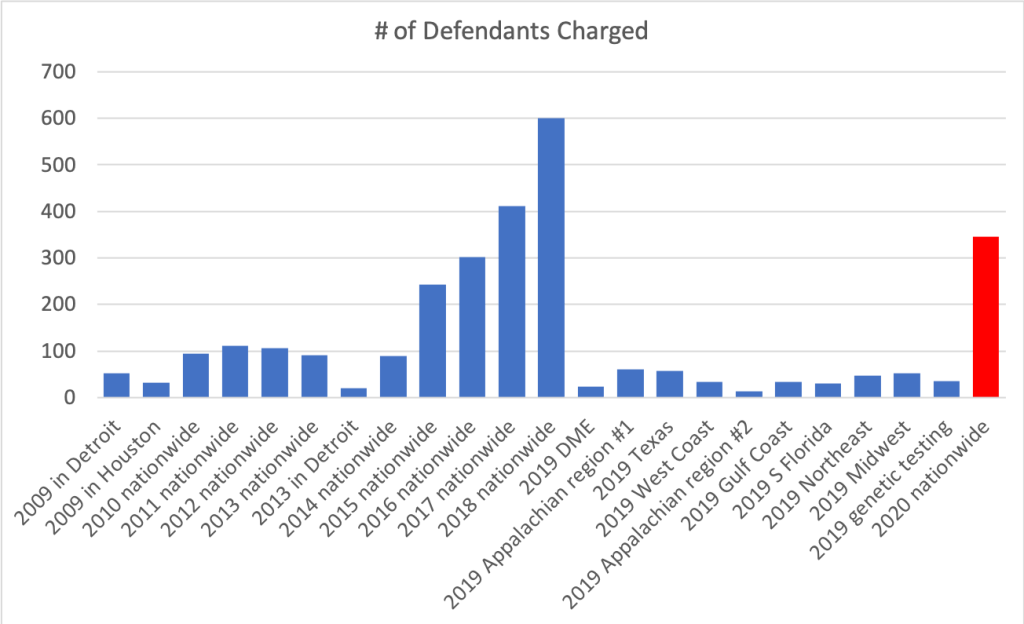
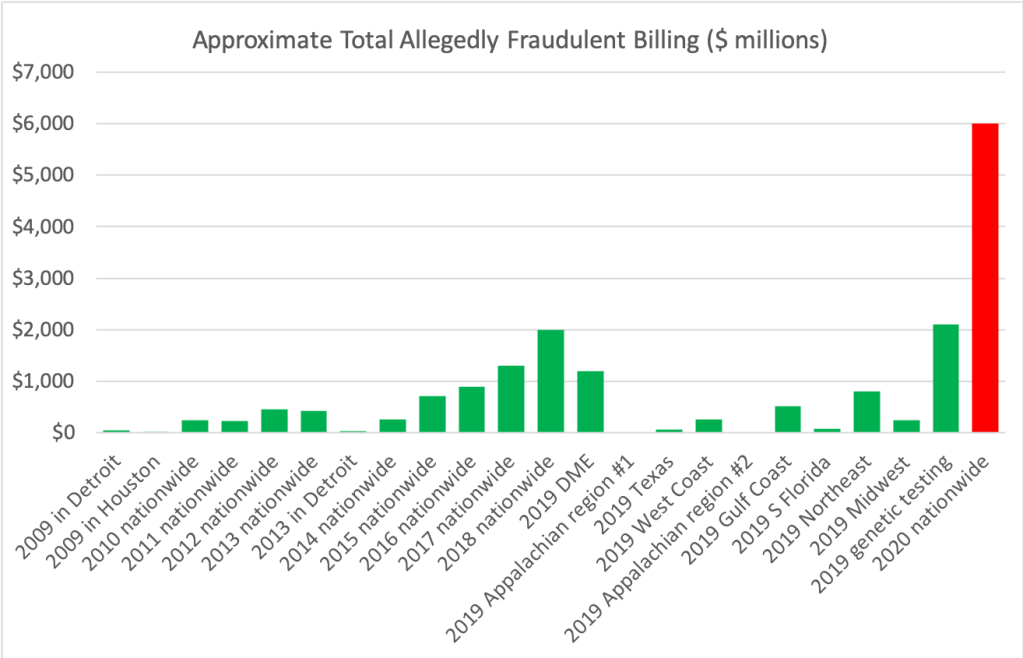
In prior takedowns, the government measured the size of a takedown by the number of defendants charged and the amount of allegedly fraudulent billing.

By number of defendants, this takedown fell far short of the 2018 takedown, which involved almost twice as many defendants as the 2020 takedown.

By amount of allegedly fraudulent billing, the 2020 takedown is indeed the largest, but the government apparently got there by applying a new way of counting that is shaky and potentially misleading.

Based on my review of the cases counted by the government as part of the 2020 takedown, many of the cases were NOT charged on or around the date of the “takedown,” in contrast to prior takedowns.  Instead, about half the cases actually were charged more than a month earlier, some many months earlier.  And about 25 percent of the cases had already been announced by the Department of Justice, and a few had even been announced as part of last year’s takedowns.

Unfortunately, this raises concerns about the credibility of the government, or at least some parts of the government.  I was an Assistant United States Attorney in Chicago for 11 years and was senior counsel to my office’s healthcare fraud unit from 2017 through early 2019, and I did not see anything like this in my time (I want to point out that my old office’s numbers look fine, and I have no problem with how its cases were counted as part of the takedown).

Here’s some context.

The federal government began doing healthcare fraud (“HCF”) takedowns around 2009, and the first HCF takedowns were definitely “takedowns” in the sense of coordinated law-enforcement actions that occurred simultaneously to stop ongoing criminal conduct.  In June 2009, agents conducted an “early morning takedown” resulting in multiple arrests that day in a few cities.  A month later, agents conducted a similar “early morning takedown” resulting in arrests that day.  and

HCF takedowns became national from 2010 through 2018.  Most years, the number of people who were charged increased, and the total amount of claimed losses increased.  The takedowns also shifted away from arrests that occurred that day to cases that were charged on or shortly before the takedown.  I’m okay with this, even if it arguably is stretching the definition of “takedown.” In those years, takedowns counted the following:  arrests, searches, new charges, and the announcement of recent charges.

In 2019, the government shifted its press strategy.  Instead of announcing one HCF takedown for the entire year, the government announced multiple HCF takedowns focused on a particular healthcare sector or geographic region.  One (Brace Yourself) focused on durable medical equipment, another focused on genetic testing, and others focused on Texas, the West Coast, the Appalachian region (two takedowns), the Gulf Coast, South Florida, the Northeast, and the Midwest.

The DME takedown in April 2019 was a classic “takedown,” involving coordinated arrests based on sealed indictments, the execution of 80 search warrants, and administrative actions against multiple companies.  And I think that this was a great strategic move for the government – it spotlighted a major problem that I have written about elsewhere and has had significant impact even beyond the specific people who were arrested.  

But I noticed something odd about at least one of the regional takedowns in the fall of 2019. 

In the Texas press release, the Department of Justice announced enforcement actions, charges, and arrests that occurred “today.” 

But the government had already charged many of the people mentioned in the press release much earlier. 

Of the 21 people who were specifically cited as being charged in the Northern District of Texas, 10 had actually been charged much earlier and had even been the subject of prior DOJ press releases. 

  • Seven people had been charged in March 2017, when a press release was issued.  One of the defendants pled guilty in July 2019.  The government then re-charged the six remaining defendants and added a seventh in September 2019.
  • One had been charged in 2018, when a press release was issued.  This defendant had been arrested in June 2018 and apparently had considered pleading guilty.  The government then re-charged the defendant in September 2019.
  • And two more had been charged in the DME takedown months earlier.   The government then brought new charges against the defendants in September 2019.

This struck me as odd and potentially troubling.  Yes, there technically had been some government actions in September 2019 as slightly new charges were brought against each of these defendants, but these normally would not have been significant or worthy of a press release.  Moreover, the press release made it sound like these people had been arrested “today,” rather than re-charged slightly in the past few weeks.

In 2020, the government went back to announcing one national takedown, which it did on September 30.  The government referred to “today’s enforcement actions” and “the cases announced today,” and claimed that this was the “largest health care fraud and opioid enforcement action in Department of Justice history.”

But let’s take a closer look at the “takedown.”

First, in terms of the number of defendants, the 2020 takedown falls far short of prior takedowns.  There were 345 defendants announced in the 2020 takedown, just over half the number announced in the 2018 takedown two years earlier.  

Graph showing number of defendants charged in U.S. takedowns, based on press releases

Second, the 2020 takedown is the largest in terms of the billings that the government has claimed were allegedly affected by the cases in the takedown ($6 billion).

Graph showing total allegedly fraudulent billings in U.S. takedowns, based on press releases

But, as mentioned above, the government counted a lot of older cases for the takedown and appears to have re-defined what a “takedown” is.

In the takedowns from 2015 through 2018, the vast majority of cases were charged around the time of the takedown.  About 85 percent or more of the cases that were designated as part of the takedowns were charged in the month prior to the takedown announcement.

But in 2020, only about half of the cases that were officially designated as part of the takedowns had been charged in the month prior to the takedown announcement.

The 2020 “takedown” was not a coordinated series of arrests that occurred on or about the same day.  It was not even a collection of cases that at least occurred shortly before the announcement.  Instead, it was more of a conglomeration of cases over the course of the past year, most of which had nothing to do with the others.

If you take out the older cases so that you can compare apples to apples, the 2020 takedown still shows some impressive work by prosecutors and agents, particularly in light of the challenges of investigating crimes during Covid, but it probably is not “historic” and may not be the “largest.”

(If you want to check my numbers, the government has made available indictments and other charging documents for many of the cases in the 2015, 2016, 2017, 2018, and 2020 takedowns.  Most indictments clearly show when the charges were filed, and I’ve cataloged them by when they were charged in relation to the respective takedown.)

Third, the government counted several older cases that had already been announced and covered in press releases.  On top of arrests, searches, new charges, and new announcements of recent charges, the government apparently now counts “re-announcements” as a law-enforcement action.

  • For example, the government included three cases from Florida which had been charged and announced in 2019:  one (McNeal) had been announced in April 2019 as part of the Brace Yourself takedown, and two (Kahn and Karlick) had been announced in September 2019 as part of that year’s South Florida takedown.
  • The government counted several Covid-related cases which had been the subject of press releases in May and June in Georgia, Arizona and California
  • The government included multiple cases relating to Indivior Solutions, which pled guilty in July 2020 relating to the marketing of the opioid-addiction-treatment drug Suboxone back in 2012. 
  • And, like in Texas in 2019, the government again counted slightly modified charges against people who were charged much earlier and had already been the subject of press releases:  a couple who had been involved in a compounding scheme that allegedly ended in 2015 and whose charges were announced in 2018, and a nurse who had been charged for aiding a doctor in committing fraud from 2015 through 2017 and whose charges were announced in 2019

I was a prosecutor for 11 years and I was a reporter before that, and I believe that coordinated government actions and press releases can be effective tools to stop and deter crime.  But I also believe in accuracy and I think it is misleading to claim that unrelated cases that were previously charged and that were previously announced are part of a later “takedown.”

Why does this matter?

First, public companies and their officers commit securities fraud when they manipulate their numbers to make their quarterly or annual results look better than they actually were.  The government should not be engaging in similar conduct.  

Don’t call it a takedown when it’s not really a takedown.  Call it a review or update of cases that have been charged in the past year.  This probably will get fewer headlines, but at least it will be accurate.

Second, re-announcements could violate DOJ rules and affect pending cases.  Re-announcing a case for a second time just to pump up the numbers for a subsequent takedown causes confusion and could prejudice defendants who were previously charged.  Defense lawyers should consider filing motions if the government has re-announced their clients’ cases while the cases were pending, and defense lawyers should consider asking judges to order the government to not do this with their cases.

Third, reporters should review the DOJ’s announcements more carefully going forward.  The next time the government announces a “takedown,” make sure that it actually is what the public would consider a takedown before calling it such.  If the announcement is simply a list of cases that were charged in the past six months or a year, call it that, especially if the cases involved criminal conduct that ended years earlier.

Takedowns can and should continue to be effective tools for law enforcement, but I hope the government is more careful about what it counts and says in the future.

Here is some additional information for disclosure and methodology.  When I was in the government, I charged cases that were part of the 2012, 2014, and 2018 takedowns – all my cases were charged on or shortly before those takedown announcements.  I noticed the DOJ’s use of old charges while looking at the 2020 takedown, and then decided to check all of the charging documents that the DOJ made available for the cases in the 2020 takedown and to compare the results to the annual takedowns in 2015, 2016, 2017, and 2018.  I then ran Internet searches to find press releases that had been previously issued for many of the cases in the 2020 takedown.  This did not take long once I knew what to look for.  Please contact me at slee@beneschlaw.com if you’d like to see my work.

Stephen Lee was an Assistant United States Attorney in Chicago from 2008 through 2019 and served as senior counsel to the healthcare fraud unit in the U.S. Attorney’s Office for the Northern District of Illinois. He is now in private practice in Chicago. In his first year in private practice, he was counsel to a doctor in a seven-week Medicare Strike Force trial in the Southern District of Texas, in which he helped win the acquittal and dismissal of multiple charges, including all charges against three co-defendants.
Breakdown of the Takedown 1: “Doctor-Enabled” Fraud in DME

On September 30, the federal government announced its annual healthcare fraud takedown, which involved 345 charged defendants and a lot of work by prosecutors and agents.

I wanted to offer some perspective on the takedown, based on my own time as a former federal prosecutor who handled many healthcare fraud cases and as an attorney who now is in private practice.  

Today, I want to start by discussing the largest part of the takedown, which is a continuation of the government’s investigation of fraud involving durable medical equipment, “Operation Brace Yourself.”  This investigation was publicly announced in April 2019 and has continued into 2020, when the government announced more DME fraud charges.

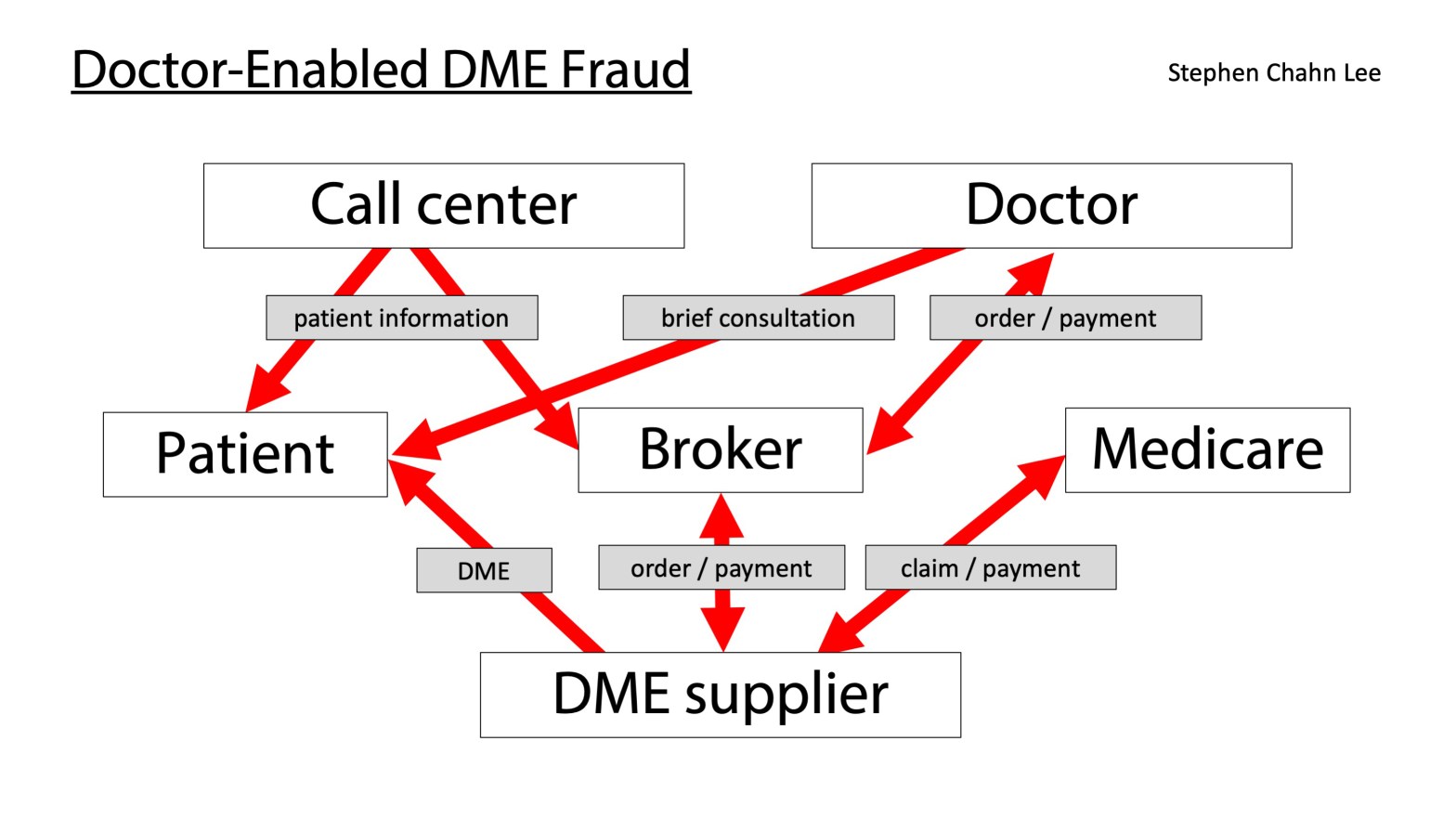
Overall, the kind of fraud that the government has targeted with “Operation Brace Yourself” is a type of fraud that I prosecuted and spoke about when I was a federal prosecutor, what I call “doctor-enabled” healthcare fraud.  On Medicare’s behalf, I explained how “doctor-enabled” healthcare fraud worked in a different context (home health) in a Special Medicare Open Door Forum in January 2017, and the same patterns are at work in Operation Brace Yourself and similar government investigations.  

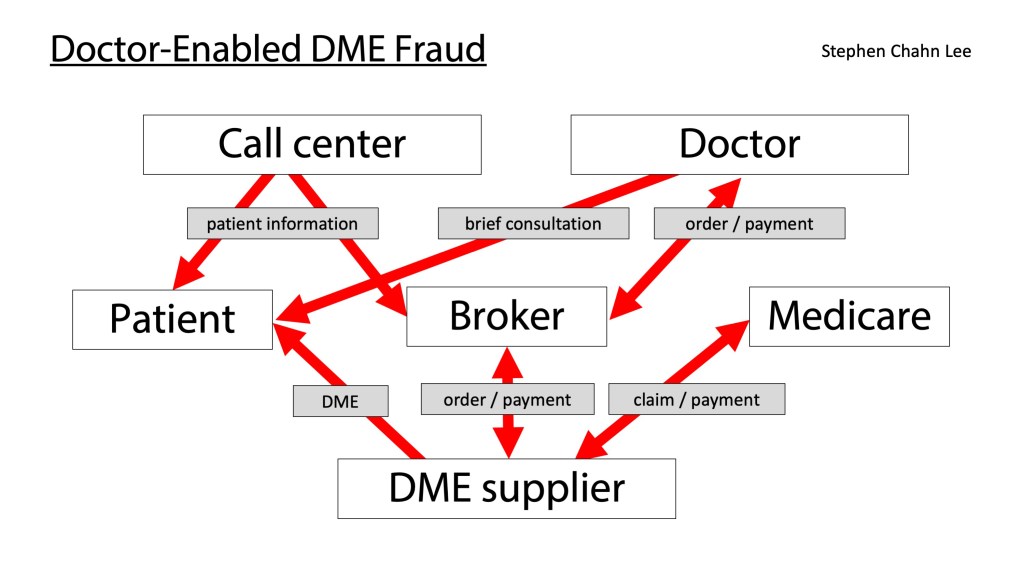
In “doctor-enabled” healthcare fraud, doctors are not driving the fraud and they often are not making much money from the fraud.  Instead, someone who is not a medical professional uses (a) doctors to enable the billing of claims that benefit the non-medical professional, (b) marketers to solicit patients, often via misleading tactics and payments that violate the Anti-Kickback Statute, and (c) brokers who help arrange everything.

The complicated diagram below summarizes the overall system described in many of the cases in the 2020 takedown.  If it helps, I walk through this diagram in a video that you can access by clicking here or on the diagram.

To understand how the fraud works, let me first explain how DME typically is ordered for Medicare patients.  The patient sees his or her doctor about a medical problem, and the doctor recommends DME as part of the treatment.  The doctor then sends an order to a DME supplier.  The DME supplier sends the DME to the patient, bills Medicare for the DME, and is paid by Medicare.  The doctor continues to treat the patient and sees how the DME works.

In “doctor-enabled fraud,” things work very differently.  Instead of a doctor driving the process, the process is driven by a non-medical professional, typically a broker who works with and for DME suppliers.

  • Step one.  The non-medical professional uses marketers to find patients and pays the marketers, often on a per-patient basis that can violate the federal Anti-Kickback Statute.
  • Step two.  Many of these patients already have primary-care physicians who probably would not be receptive to getting asked by a marketer to order braces for their patients.  Patient brokers then go around the patient’s primary-care physician by using doctors who have no prior relationship with the patient and who have some financial incentive to order the services or items that would benefit the non-medical professional.  Often, the doctors who “enable” the fraud are getting paid very little compared to other people.  In many of the cases that are part of the 2020 takedown, doctors were getting paid just $20 to 40 per consultation or order, a relatively small amount given how much those orders cost Medicare.
  • Step three.  The broker sells or provides the order to a DME supplier.  The DME supplier then sends the DME to the patient, bills Medicare, and gets paid by Medicare.  But as a result of this system, patients often get DME that is not actually needed or helpful, and Medicare pays for large amounts of unnecessary DME.

This overall system has cost Medicare billions of dollars and explains one thing that you might find odd about the government takedowns.  In each of the takedowns from 2014 through 2020, the vast majority of people who are charged with healthcare fraud crimes are NOT medical professionals, but businesspeople or marketers or other non-medical professionals.  Medical professionals have made up less than 30 percent of the people charged in each of the takedowns for which the government has supplied this information.

This system also explains some of the red flags that I have observed in publicly available Medicare data.

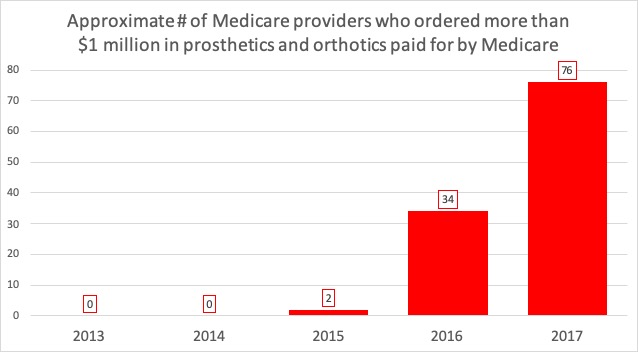
Consider this.  In 2013 and 2014, according to publicly available data, there were no Medicare providers anywhere in the country who ordered more than $1 million in prosthetics and orthotics that were paid for by Medicare.  Similarly, there were no Medicare providers anywhere in the country who ordered prosthetics and orthotics for more than 1,000 Medicare patients.

That changed.

 Approximate # of Medicare providers who ordered more than $1 million in prosthetics and orthotics paid for by MedicareApproximate # of Medicare providers who ordered prosthetics and orthotics for more than 1,000 Medicare beneficiaries
201300
201400
201521
20163422
20177657

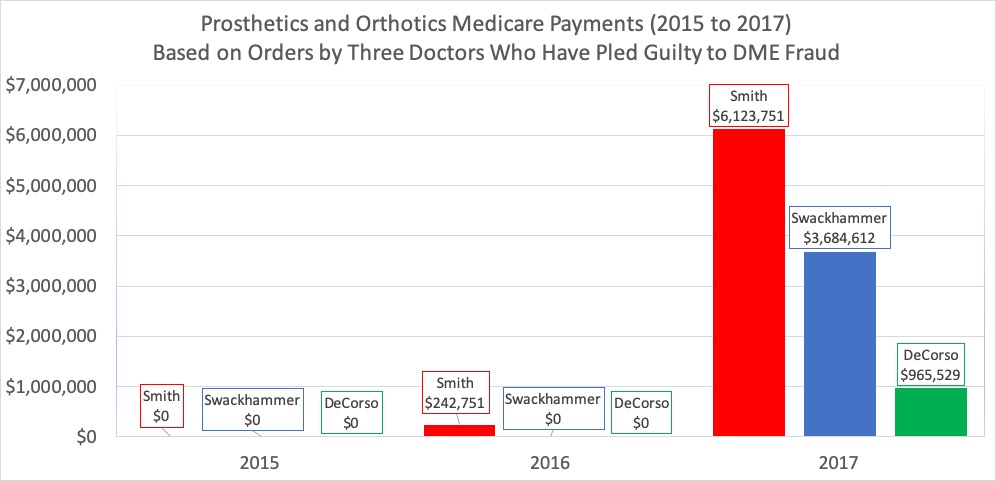
By 2017, there was a large number of Medicare providers who were ordering huge amounts of prosthetics and orthotics, including several doctors who have been charged in the 2019 and 2020 takedowns and who have already pled guilty (the number probably grew in 2018 and early 2019, but data is not yet publicly available).  The graph below shows how the payments associated with three doctors (Alleyne Smith, Randy Swackhammer, and Joseph DeCorso) grew suddenly in 2017.

None of these doctors ordered any prosthetics or orthotics in 2015, according to Medicare data.

But by 2017, each was in the top 100 of Medicare providers around the country in terms of Medicare payments for prosthetics or orthotics.  Based on my review of the data, each ordered more than $1,000 of prosthetics or orthotics for large numbers of patients.  DeCoroso ordered an average of approximately $1,200 in prosthetics or orthotics for more than 800 Medicare patients, and Smith ordered an average of approximately $1,500 in prosthetics or orthotics for more than 3,900 Medicare patients.

What changed?  When DeCorso pled guilty in 2019, he admitted that he worked for two telemedicine companies for which he wrote medically unnecessary orders for orthotic braces.  He admitted that he wrote brace orders without speaking to the patients and that he concealed the fraud with falsified orders stating that he had “discussions” or “conversations” with patients when he had not actually done so.

While doctors like Smith, Swackhammer and DeCorso have pled guilty to DME fraud, these cases sometimes can be challenging for the government.  Generally speaking, the government cannot convict someone of healthcare fraud unless the government can prove that the person knew that what they were doing was illegal.  That can be difficult when the doctors have little knowledge of the overall system and are receiving relatively small payments.  If a doctor really was naïve or careless or gullible, then the doctor would not have the “willfulness” necessary to be convicted of healthcare fraud. 

Doctors involved with DME or other high-risk areas can alert themselves to potential “doctor-enabled” healthcare fraud by asking themselves a few questions.

  • Do you know where your patients came from?  Are they actually reaching out for help, or have they simply been solicited by marketers?
  • Are you actually treating the patient, or are you just ordering one or more particular items or services that you would not order in my typical practice?
  • If you are given forms or EMR to fill out, is everything there actually true before you sign?

I hope you enjoyed this perspective.  I’ll be covering other aspects of the takedown and healthcare fraud in future posts, including how and why doctors should look at their own data to understand how they may be viewed by the government.

Stephen Lee was an Assistant United States Attorney in Chicago from 2008 through 2019 and served as senior counsel to the healthcare fraud unit in the U.S. Attorney’s Office for the Northern District of Illinois. He is now in private practice in Chicago. In his first year in private practice, he was counsel to a doctor in a seven-week Medicare Strike Force trial in the Southern District of Texas, in which he helped win the acquittal and dismissal of multiple charges, including all charges against three co-defendants.